Palm Sunday
Yesterday in church, but not evangelical

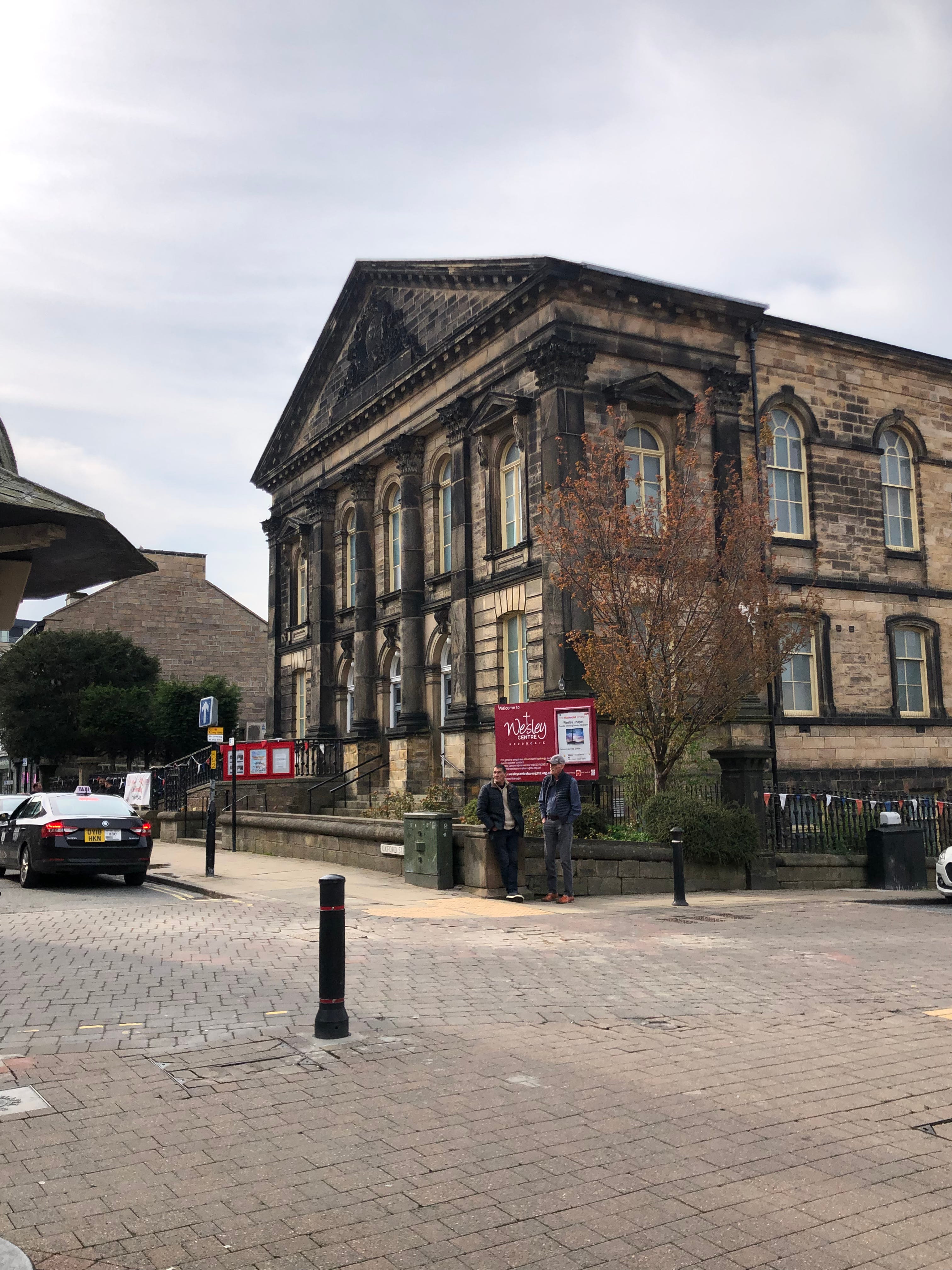
I go to Harrogate’s Wesley Chapel, which is part of The Methodist Church in the U.K., and has a congregation of clever, kind, welcoming, ancient people. I am so lucky to be a part of the community, which is functional in every way I can think of if you aren’t counting athletics or expected longevity. At 65 I am a relative youngster. Two regulars are younger: my husband Sheeyun, at 55, and Dorothy, who I’d guess is in her forties or conceivably fifties. Sheeyun and Dorothy are the only regulars who are people of color. Which isn’t a plus, but this is Yorkshire.
To be a Methodist church is to be connectional, to be part of a circuit of Methodist churches and other ministries, and to have ordained clergy who itinerate, or move from one congregation to another. When I was pastoring in the United States and in my conference, that meant that a pastor was appointed to 1-3 churches and served there for the coming year. (Appointments typically lasted for more than one year, but they might not. The Methodist-style Princes of the Church spend decades in large-congregation well-financed churches. No doubt optimally for congregation, pastor, and the world as a whole.)
Here, we are in a circuit of thirteen churches served by four active ordained-to-communion-giving pastors, one of whom is retiring in three months. They, and one deacon, and a couple of retired full-ordained Methodist pastors, and licensed lay preachers, and people who work for charities in youth outreach or elder care, circulate around the circuit, lead services and preach, and try to offer communion in every church once a month. And then there are about twelve Local Arrangements a year, in which a congregation comes up with something on its own.
Yesterday was a bit of a festival day, with Gordon, the ordained pastor assigned to us* preaching.
And he came in very strong, to my mind, though Sheeyun thought it was just a usual Palm Sunday sermon, which to be honest are not usually very strong.
Gordon started with a slide displaying photos of historical events he asked us to identify. The liberation of Paris, the fall of the Berlin Wall, the freeing of Nelson Mandela, Arab spring. And he had us talk and talked with us about commonalities among these scenes.** (I said that they represented the liberation and exhibition of the power of the people, from under empire.)
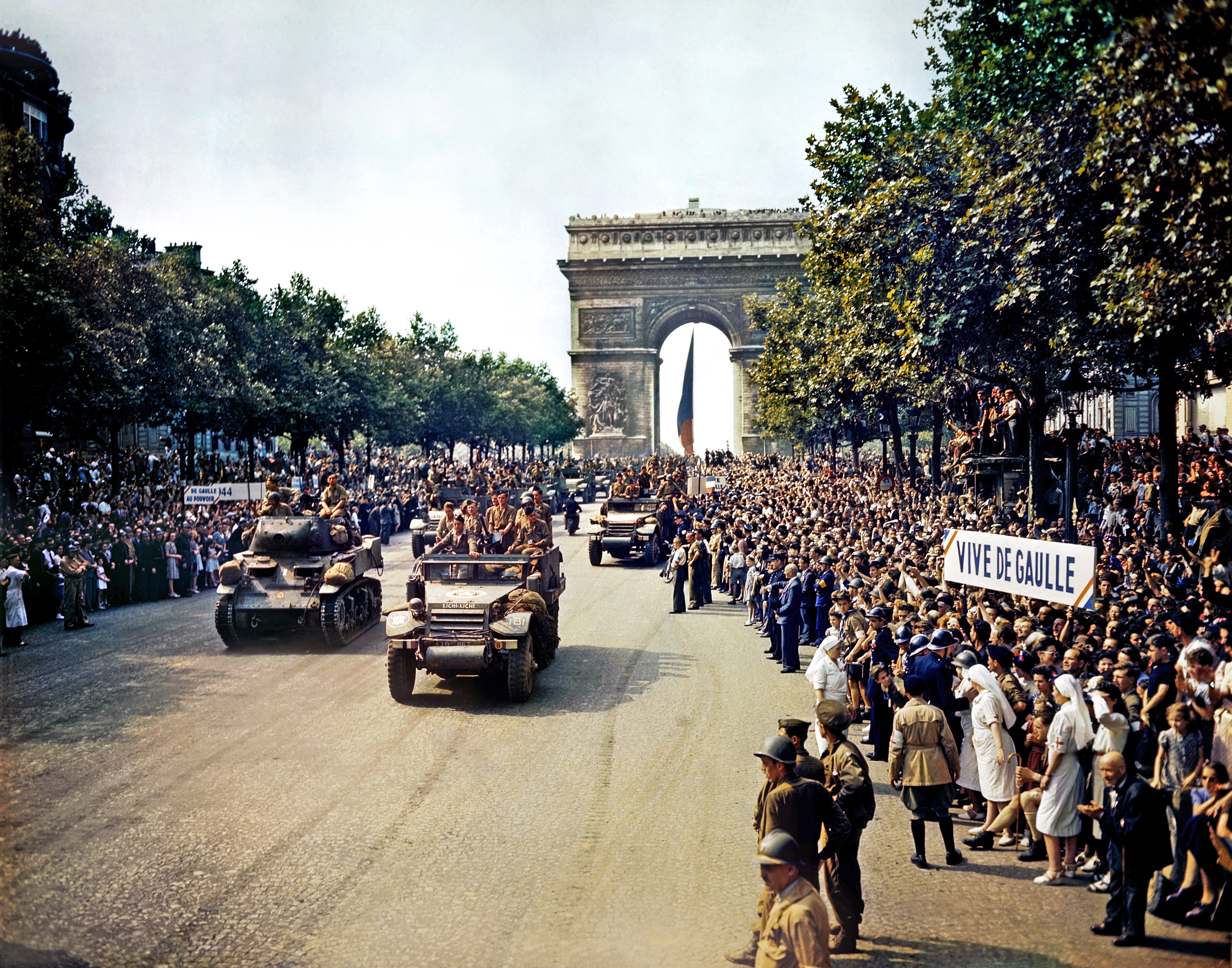
Photo: Crowds of French patriots line the Champs Elysees to view Free French tanks and half tracks of General Leclerc's 2nd Armored Division passes through the Arc du Triomphe, after Paris was liberated on August 26, 1944. Among the crowd can be seen banners in support of Charles de Gaulle. By Jack Downey, U.S. Office of War Information - This image is available from the United States Library of Congress’s Prints and Photographs divisionunder the digital ID fsac.1a55001.This tag does not indicate the copyright status of the attached work. A normal copyright tag is still required. See Commons:Licensing., Public Domain, https://commons.wikimedia.org/w/index.php?curid=7453927
From there he verbally presented contrasting images of Jesus of Nazareth’s weird little procession into Jerusalem, as compared with what a procession by Pontius Pilate would likely have been, when he traveled from the administrative city of Caesarea into Jerusalem.
And I thought about No Kings Day and the incessant Trumpian performance of empire and thus of attempted appearances of invulnerability, infinite resources, and ultimate power. (I would find out ex post that he hadn’t heard of it.)
And I thought about how resistance and history proceed in waves, and each wave leaves a mark, though early promise is practically never the whole game and hopes are often dashed. Indeed, Gordon talked about that.
I thought, what a good buckle in/down Sunday.
* I have no idea at all what the assignment means in this context.
** Catherine startled me, and probably others, by saying that all the scenes was bad, Oh What a World. Afterwards, when I told Gordon how much I’d enjoyed the service and his sermon, I said that I did hope that Catherine didn’t regret the liberation of Paris…. He as well. Both of us thought this might have had to do with Arab Spring. Anyway, he handled it well at the time. Catherine startled me at tea around a year ago, and I came to the conclusion that that was being a royalist….

Photo: People gather near Philadelphia City Hall for the No Kings protest and march down Ben Franklin Parkway on Saturday.Elizabeth Robertson / Staff Photographer. https://www.inquirer.com/news/philadelphia/no-kings-protest-rally-philadelphia-new-jersey-2026-20260328.html
Lagniappe:
For a very long time I have had an irritation-prayer: I pray it less only than the Lord’s Prayer. It goes: Please give us all kinder hearts, better sense, and the will to make a more sustainable and equitable world.
And now I have another prayer I think I’ll be using on the regular: Please help me to do the best I can. Please help me to do better than I can.
Talking over dinner with Sheeyun, we agreed that almost surely the image of Jesus’s and Pilate’s opposing processions was more familiar to him than it was to me or to Gordon. Protestant Christianity in Korea is thoroughly braided with resistance and with liberation theology, and Sheeyun and I both anticipate that this emerged readily of a Palm Sunday.

Photo: Protester, Gunnison, Colorado. https://coloradosun.com/2026/03/28/no-kings-colorado-rally-politics/