Reader expectations
Commonplace book

"What people *expect* is a very powerful element in their reading. A good of readers, whether they are nine or ninety, are truly uncomfortable with anything that strikes them as new or different-- that is why soaps are so popular-- and some people get quite petulant if they get what they don't expect. Minor examples of this are two reviews I got recently of my book Year of the Griffin. One was quite short and said, more or less, `This isn't Harry Potter so I don't like it.' The other was longer because the reviewer went through the book side by side with the latest Harry Potter, saying where they didn't match. The extraordinary thing is that he should have *expected* them to match."
- Diana Wynne Jones (2012). Reflections on the Magic of Writing. Oxford and New York: David Fickling Books, 192.
Here by "soaps" Jones means soap operas, which may change quite a lot over long arcs but very little from day to day.
Jones is of course quite right about the shoddy silliness of that sort of review (though the reaction is of course legitimate to the person who has it and wants only J.K. Rowling). You encounter it in all sorts of forms, including the extremely commonplace dismissal of a political position for not addressing this, that, or the other thing. Not every political position is required to comprehend the entire universe, even the entire political universe, and in fact few do. I tend to respond with "Yeah, and it also doesn't include a recipe for egg salad so good you could plot," which of course usually makes no sense to those hearing it.
There are other interesting things about reader expectations from the other way round, too. Jones talks about readers who come to a book with distinct expectations they know are being violated, and are cross about it. But a reader can come to a text with expectations and read the text through the lens of those expectations.
As a personal example I find pretty funny, when I was in seminary I was aware of being incredibly ignorant about the U.S.'s conservative, "evangelical"* Christianity, so I tried to learn about it. At the same time I was putting in extra work to read canonical Christian classics and some Christian "spiritual" or "woo-woo" stuff. And one day I started a new audiobook and thought, oh, man, these woo-woo evangelical books, starting with warnings about being all about sacred secrets-- and it was the contemplative classic "The Cloud of Unknowing," from the 14th century.
Vladimir Nabokov's Pale Fire is a tragi-comic work pairing a poem and a narrative-of-misreading. The poem is by an aging scholar writing in sorrow about his daughter's death. The annotating reader has been dogging his steps in the small college town the poet lives and works in, who believes that he is Ruritanian royalty. He interprets the poem as an encoded account of his situation and of the assassin he believes is coming for him.
Think about reading a novel in which a death occurs. Is it a murder mystery? Some novels containing deaths are mysteries and some are not. And how you read the book is likely to depend on what sort of book you think it is. Most readers don't read to solve a straight novel: most readers do have eyes to clues, and make inferences as they read mysteries.
An entire area of scripture interpretation was created as 19th-century German scholars recognized the possibility and importance of disconnect between the function of a text in the societies it was written for, and today's readers. To take an obvious example, it matters whether we read Genesis 1 and 2 as literal accounts of the beginning of the world/reality or as poetic myth.
* The quotation marks are because the term "evangelical" often has the implication of theological and political conservatism in the U.S., but it also simply means "bringing the good news," or evangelizing, and trying to convert people, and the political and more basic sides aren't identical. I was thinking of the U.S. cultural package of theology, politics, and style.
.
.
... And why is it we're supposed to hate immigrants and be so hateful to them? There'd better be a good reason before we started gravely considering exactly how hateful we should be, right?
Let us notice the whos and the whoms, present and absent, in news and discourse.
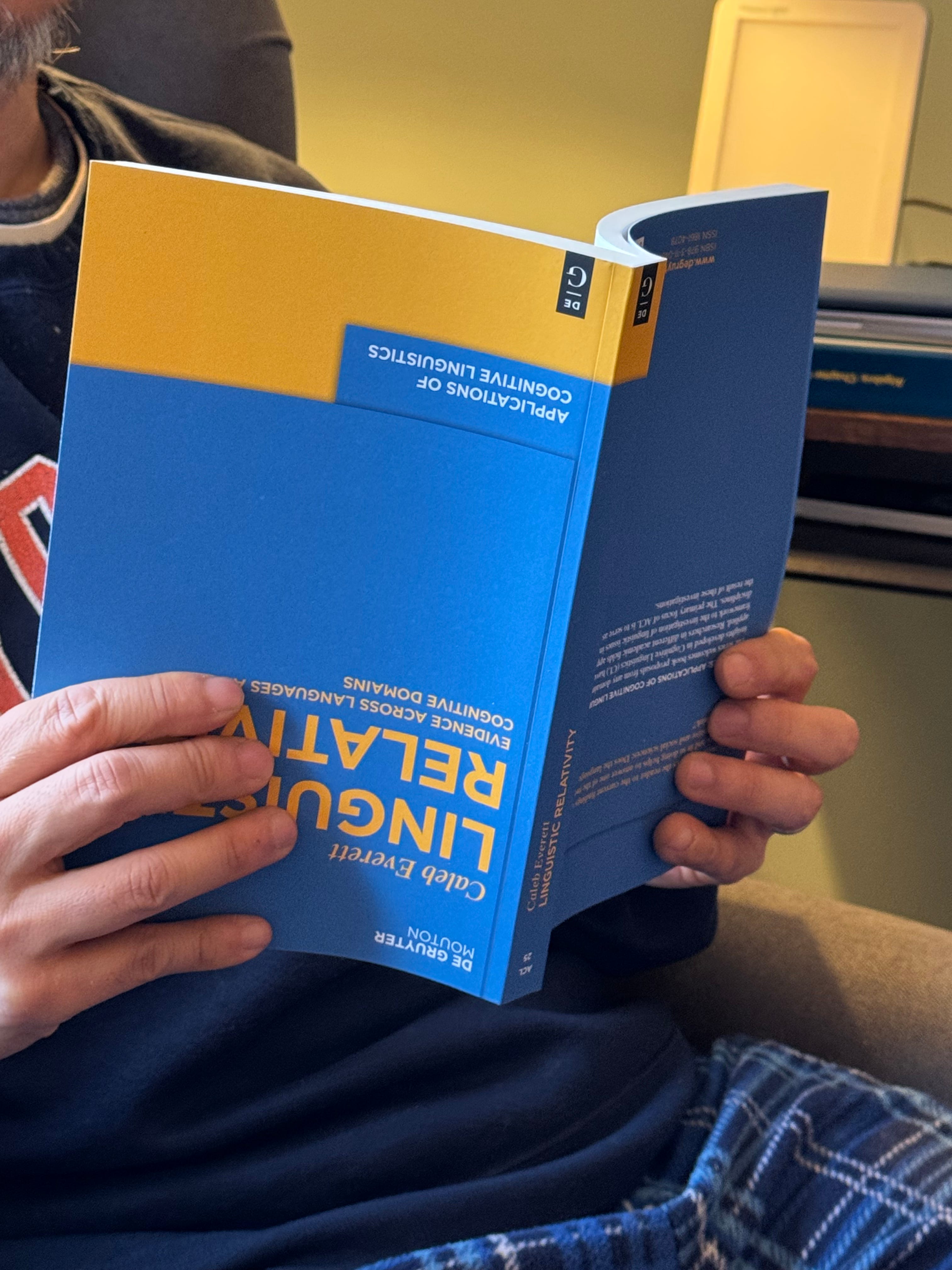
I think maybe on the whole, my understanding of whatever I have just encountered is influenced more by my expectations and frame of reference than by actual content. Which I suppose must also be the point of the Caleb Everett reference, though I have not read his work.